- Perplexity → company research, product understanding, surface-level context
- OpenAI → evaluation, synthesis, filtering signal from noise
- Anthropic (Claude) → copywriting based on structured inputs
How I Scale Cold Email Campaigns
This page outlines the system I use to scale cold email to 100+ demos/mo.
No hacks or tips & tricks, just a reliable system.
When people hear "scale," they usually think about volume, but in practice, scale only works when deliverability, targeting, and messaging are solid. Without those, you can forget about cold emails in the first place.
What "Scale" Actually Means Here
When I talk about scaling cold email, I usually mean:
- 300,000–800,000 total emails per month
- Including follow-ups
- Which typically equals ~100,000–265,000 unique leads reached per month
Setting the Foundation
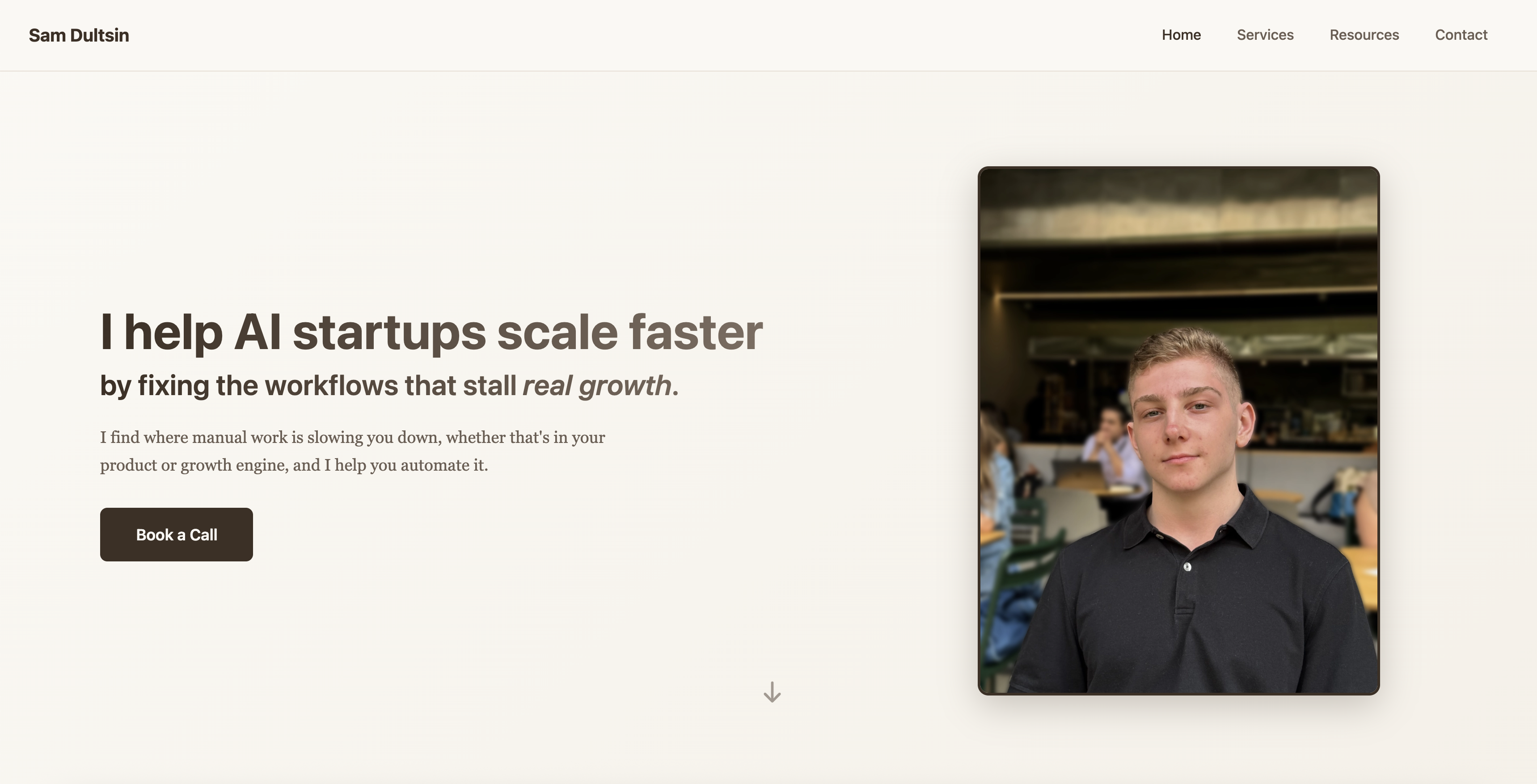
Before writing a single email, I built the website you're on right now.
Aside from branding, it fits more than a resume ever could and does so in an interactive way. It shows how I think, build, and solve problems.
I learned vibe coding with Claude and YouTube tutorials, practiced with a mock AI SaaS site, and then built this one in a week using VS Code, Claude, GitHub, and Vercel.
Once the site was live, the next step was directing the right kind of traffic to it.
1. Infrastructure
Before copy, leads, or automation, the sending foundation needs to be solid.
Domains & Inboxes
- Domains purchased through registrars like Porkbun or Namecheap
- Google and Microsoft inboxes bought through a mass inbox vendor
Sending Platforms
Warm-up and sending handled in platforms like Instantly or Email Bison.
These platforms handle:
- Warm-up w/ a private IP pool
- Follow-ups
- Deliverability monitoring
2. Lead Sourcing
Leads are found through Apollo and LinkedIn Sales Nav and scraped using a third-party scraper.
3. Email Verification & Inbox Matching
Before any enrichment or copywriting happens, leads are filtered in a few ways:
- Email verification
- Catch-all verification
- ESP matching (Gmail → Gmail, Outlook → Outlook)
Sending from Google inboxes to Microsoft inboxes (and vice versa) does affect inbox placement.
This step quietly removes a large percentage of bad sends before they can do damage.
4. Research & Enrichment
This is where most cold email systems either shine or collapse.
I use Clay as the orchestration layer (n8n as a more technical alternative), combined with multiple LLMs depending on the task:



Chronologically, it looks like:
- Research (Perplexity)
- Evaluation (OpenAI)
- Writing (Claude)
This keeps copy grounded in reality instead of templated fluff.
5. Copywriting
I never start with scale. Initial setup usually looks like:
- 5–10 ICP variations
- ~20 messaging angles
- Low send volume
- Fast feedback loops
The goal is to find:
- What actually gets replies
- What gets positive replies
- What converts to meetings
Only once an angle proves itself does scale make sense.
6. Follow-Ups
Initial emails are written upstream. Follow-ups are handled inside the sending platform (Instantly, Email Bison, etc.).
Worth noting that leads can be added to the CRM and contacted on LinkedIn and/or cold call for multiple points of contact.
7. Scaling the System (Not the Guess)
Once an ICP + message combination works:
- I increase volume by adding more domains and inboxes
- Repeating this process
8. Safety and Deliverability
This deserves its own section because everything else depends on it.
Key principles:
- Warm-up before volume
- Conservative daily send limits
- Continuous inbox and domain health monitoring
- Immediate pullback if deliverability drops
Cold email only works if you earn inbox trust. If deliverability fails, copy, tooling, and targeting become irrelevant.
A Simple Conversion Model
To visualize these numbers, here's an estimate:
| Total emails sent | 500,000 |
| Total unique leads contacted | 165,000 |
| 1% reply rate | 1,650 replies |
| 25% positive replies | 412 positive replies |
| 40% meetings booked | 165 meetings booked |
| 60% meeting show rate | 100 showed up |
| 20% closed | 20 closed |
These are conservative estimates. Of course as you scale, you improve your outreach, and bump these %'s up.
If this sounds interesting, let's talk.